


ARTIST
Mohammed El Hajoui
CRITICAL TEXT
Emanuela Zanon
DURATION
24.10-29.11.2025
HOURS
Tuesday to Saturday, 4:00–7:30 PM. Closed on November 25.
FINITO-ATBA-INFINITO
24.10-29.11.2025
INTRODUCTION
PRESS KIT
CRITICAL TEXT
PREVIEW
APPOINTMENTS
INFO
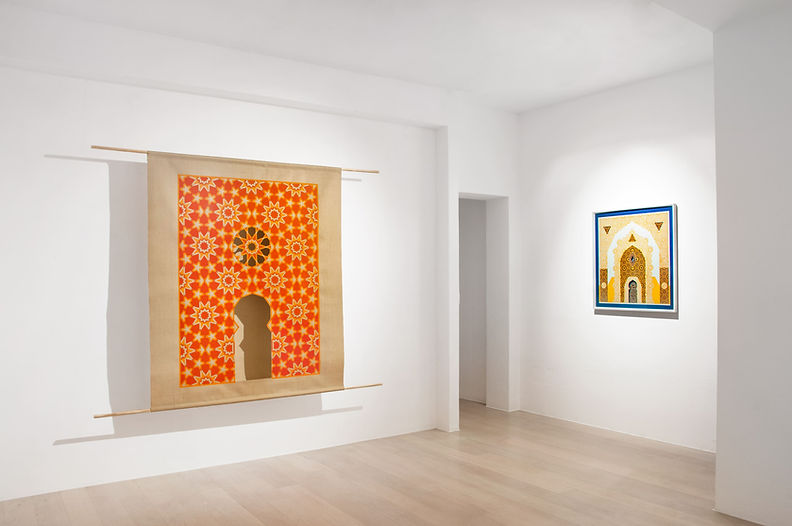
On Friday, October 24, from 5 to 8 pm, Studio la Linea Verticale opens Finito–Atba–Infinito, a solo exhibition by Mohammed El Hajoui, accompanied by a critical text by Emanuela Zanon. The exhibition, open until November 29, unfolds as a symbolic itinerary that, starting from the limits of the human condition, crosses a threshold to reach a dimension beyond measure, where humble materials, ritual gestures, and geometric structures merge with a mnemonic and spiritual realm. Within this interplay, the works function as liminal devices: rooted in matter yet oriented toward an ascending tension that questions the boundary between the finite and the infinite. Abstract There is a point at which matter thins and allows the breath of the spirit to pass through. It is within this subtle threshold that Mohammed El Hajoui’s research moves, between roots and openings, light and ash, traces that hold memory and forms that dissolve into vastness. Finito–Atba–Infinito is a circular journey that begins from the limits of the human and crosses the “atba”—the threshold—moving beyond, where all measure is lost. “Atba” is passage, echo, rebirth: an invitation to transcend, to allow matter to open toward what has no boundaries. “I have studied my past—what I experienced as a child in Morocco with my family, the customs of my culture, the everyday life in my home, ancestral celebrations, and the concepts of faith within my religion.” (Mohammed El Hajoui) Memory becomes gesture, ritual, image. In the works on view, humble materials and geometric forms become living traces—vertical openings that pierce the horizon. Each mark both holds and releases, like a door left open: grounding itself in space while simultaneously lifting it. At Studio la Linea Verticale, this research finds a natural resonance: here, verticality is not only a direction but a language—a silent chant that invites us to recognize the longing for the Infinite contained within every earthly form.
PDF EXHIBITION | PRESS KIT


CRITICAL TEXT
By Emanuela Zanon
In the subtle interstice that separates one place from another, something essential emerges: the rise of a transformative tension between belonging and detachment, which foreshadows the act of opening oneself to the unknown—an indispensable premise of any authentic encounter. If the threshold—atba in Arabic—marks the boundary between what we know and what we might discover, the door stands as the symbolic diaphragm par excellence, crossing which identity accepts to be reshaped by the mystery of otherness. A universal emblem of hospitality, the door also underscores the separation between an inside and a potentially hostile outside, reminding us that every passage entails the acceptance of the unforeseen. For Mohammed El Hajoui, who grew up between Italy and Morocco, the investigation of the threshold as a transformative device constitutes the generative core of an autobiographically rooted conceptual process, nourished by the continuous reworking of his dual cultural belonging, and using this interstitial condition as a fundamental expressive resource. The works on paper and canvas that welcome the visitor in the first room appear as extraordinary architectures of light and void, hand-cut with a scalpel that allows no margin for error, following the trajectories of an exponential geometric graphic in which mathematical rigor converges with the rhythm of inner time. The abstract patterns reproduced by the artist, drawn from the Islamic decorative tradition of the Maghreb and the Middle East, are never didactic quotations but free personal reinterpretations, where motifs from different cultures intertwine to form a syncretic language. At the root of the chromatic choices in these works lie visual impressions charged with emotional resonance: the light blue of the walls of Moroccan houses from his childhood, the yellow of another apartment in which the artist lived, the black that guards the secret of Islamic sanctuaries visited as a child. The virtuosic three-dimensionality of the cut layers urges the gaze to penetrate beyond the lattice of those delicate interlacings and leads thought to question their dual status as both openings and barriers. El Hajoui’s doors are elegant bas-relief mirages, capable of crystallizing the imminence of a solitary passage and the sense of suspension that precedes it. The beating heart of the exhibition is revealed in the gallery’s second room, an intimate space that, in this temporary configuration, resembles a luminous crypt. Here, the artist transforms the floor into a large ephemeral carpet made of colored powders, at the center of which a monumental door (the sculptural counterpart of the perforations in the first room) rises as an inaccessible monolith. The installation requires from visitors an act of faith: to walk along the margins, accepting confinement within the narrow corridor where color has not been laid, to trace the perimeter of the work without entering it, to negotiate one’s relationship with the piece at a distance. Here, El Hajoui’s work fully reveals its paradoxical and utopian nature: the perfection of the geometric patterns created by the colored dust—resulting from hours of meticulous labor and the repetition of gestures akin to ritual—finds its completion precisely in its eventual dissolution. Dust, a humble and volatile material, is destined to be progressively undone by the passage of the audience, who, throughout the duration of the exhibition, become active agents in the work, altering its configuration. Beyond the refinement of its beauty, the rarefied mental landscape evoked by this installation expresses a complex symbolic stratification through its constituent elements. First, in Moroccan culture the carpet is the place where one sleeps, prays, and welcomes guests: more than an object, it is a witness that traverses generations, embodying their memories. Secondly, the circular movement around the central door inevitably recalls tawaf, the ritual circumambulation of the Kaaba, here secularized as an aesthetic and conceptual experience. Visitors, as unwitting secular pilgrims, circling the enigmatic sculptural core, create an involuntary collective choreography in which the individual and communal dimensions overlap. Finally, the meditative attitude required by the work originates in its very process of creation, carried out through gestures that recall the ritual prostration of prayer: bending down, placing stencils with millimetric precision, shaking the sieve to spread the powder, rising, shifting a few centimeters, bending down again. The finite lies in the obsessive circumscription of detail, the infinite in the relentless multiplication of the module, and between these two extremes—across which the artist continually moves—lies atba, the liminal space where everything is possible and the boundary between self and other becomes permeable. Mohammed El Hajoui’s works open up compelling questions about belonging and self-representation, the dialectic between control and surrender, and the continuity of forms over time. They are invitations to linger on the threshold, to look around before deciding whether to enter or remain outside, suggesting that it is precisely along that line of boundary that existence unfolds. *The word “Atba” attempts to render in an Italian phonetic form the expression “3atba,” used in digital language or informal spoken Arabic to transliterate the word عتبة, meaning “threshold.” The number 3 represents the Arabic letter ع (‘ʿAyn), a guttural sound with no direct equivalent in Italian. His works draw on references to the traditions and architecture of the Arab-Muslim world, reinterpreted as symbols of hospitality and as tools for preserving cultural roots at risk of disappearing. His path has gained recognition with the project Egira (2018–2022), dedicated to themes of transit and migration, and with the residency at Fabrica, obtained through the special prize of the Arte Laguna Prize. In 2023 he presented Radici at the Arsenale in Venice, later exhibited in Milan. In 2024 he took part in the residency at Centrale Fies, where he developed Ardna – Our Land. In 2025 he was selected as a finalist for Crea – Cantieri del Contemporaneo in Venice, confirming the growth and relevance of his artistic research.
INSTALLATION VIEW


APPOINTMENTS


Subscribe To Our Newsletter
Be the first to know updates about Studio la Linea Verticale Gallery. Receive emails about new exhibitions, vernissage and events.


